Author’s Note from Goodwin Avenue
How this book was made, and why I’m telling you

I used artificial intelligence to help write this book. To some, the conversation ends there. To others, it matters how it was used. The best I can do is explain what I did and let you decide whether to read on.
Specifically, I used AI tools to build outlines, analyze the chapters and story as it grew, draft prose, including whole chapters, critique ideas, and help with research, always checking what they told me. I then revised the book chapter by chapter, line by line, over a year and a half and hundreds of versions, keeping what was right, and cutting or changing what wasn’t. I knew how the tools could go wrong: borrowed phrasing, stylistic tics, and invented facts. I did not compose every sentence, but I revised every one, and I take responsibility for every word and idea in the book. The judgments are all mine, and so are the mistakes.
I am telling you this because storytelling is an old art, and whether by voice or by paper and pencil, the story and the words always came from the same human imagination. That is not entirely what happened here. The story came from me, but not all of the initial words did. Some began with a machine under my direction. I would rather lose a reader than mislead one.
AI is not a tool like a typewriter or a pencil. I have used a good many tools, as an engineer and a builder of green roofs, barns, furniture, and chess sets, and not one of them made the thing for me. A pencil transmits the sentence from your mind to the page. AI, with the slightest nudge, presents the sentence itself. We trade one kind of labor for another: less composing, more asking, choosing, and mending. But when a machine writes a first draft, something is lost. Writers discover their book by writing the bad version of it first. It is where the accidents happen, where the relationship between writer and words begins, and perhaps where a writer’s voice comes from. Some of that still happened to me: serendipitous accidents, a relationship with the characters and the words, even a sense of ownership and pride. I still decided, on every page, what the book says and how it says it, and for whatever I lost by using AI, I still made a story worth telling. Whether that deserves the word “author” is not for me alone to decide.
A year into my effort, I discovered that because I had used AI, the big publishers were unlikely to touch the book and many prizes would not consider it. I felt I had sabotaged my own book. So I began to research the use of AI in art, and I’ll admit it was my own prospects, not my conscience, that sent me looking. What I found were some ugly truths. The work of other writers had been used, knowingly, without their permission and without any payment to them, to teach systems like the ones I was using how to write. By then the characters were real to me and I thought the story was worth sharing, so I chose to finish. I believe writers’ work should not be used without their consent. They should be allowed to refuse, and should be paid when they agree. And AI tools should be built only on those terms. Until that time, anything made with these systems stands on work that was taken without consent, and I own up to that here.
I wanted a book about neighbors, whimsical but real, quiet and humorous, about people who simply live their lives together. From the outset, I wanted a story built around character interactions, choices, and small occasions, rather than a conventional plot. I set it in Chicago thinking of my best friend, Brian, whose family had lived there for many years, and chose Logan Square because its history fit the characters and themes I had in mind. That history goes back well before the Potawatomi treaty of 1833, a date Morris, a central character in the book, reaches when he traces his own deed back as far as it goes. And I used one of the courtyard buildings the city is known for, enlarged with some license so the characters would have space to interact. The characters emerged one at a time: Morris and his cat, who had several other names before settling on Bruce; then Jing, Carmen, and the trees. I have long wanted to tell a story in which trees’ real life is underground and we humans have the whole thing upside down, and somehow it found its way into this book. Finally came the idea of telling it across a single year and letting the seasons carry people’s lives.
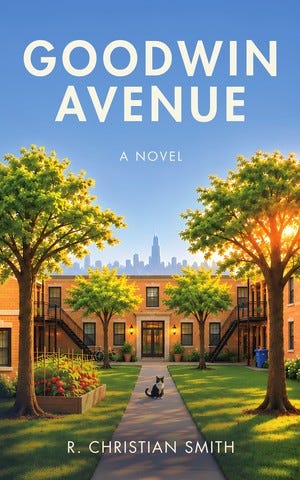
Goodwin Avenue is about people who share a courtyard. The people who built its buildings mostly could not have afforded to live in them, yet they planted trees there anyway. Everyone in the building crosses that courtyard to reach their own door. I made this book the same way, crossing ground laid by others, and I owe them all more than a note can repay.
The book is now yours.