Goodwin Avenue
Coming in early 2027 from Kimball Press
English · Español · Català
A drafty window, fixed. A jar of tomatoes.
A hand of Go Fish, played in the dark.
None of it looks like much. All of it counts.
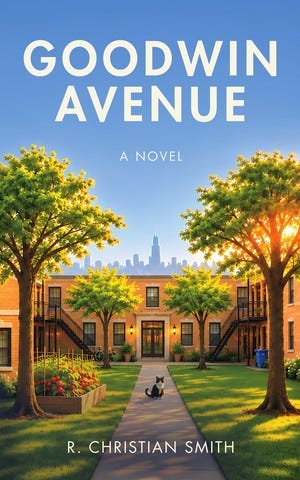
Warm, observant, and quietly funny, Goodwin Avenue follows the everyday lives of the residents of a century-old apartment building in Chicago’s Logan Square.
Morris Appelbaum is a retired accountant who helped people pay their taxes for forty years. Now he’s decided to stop paying his own, on principle, while his cat, Bruce, sleeps on the urgent tax notices. Mrs. Li sells vegetables from a folding table on trust, at prices that depend on who’s buying. Roberto can fix almost anything, though his own circumstances are proving harder to repair. Dr. Carmen Morales can save a stranger’s life but barely has time for dinner, let alone a date. And Brighton, fourteen and new to the building, watches from his upstairs window. Below them, past the frost line, four trees, with histories and worries of their own, are having a conversation nobody above can hear.
They have little in common except an address. Yet a shared courtyard has a way of bringing lives together.
Told across one year, from spring through the hard cold of winter, Goodwin Avenue is a novel about the small architecture of living together: neighbors, kale, ward meetings, and roots that go deeper than anyone can see.
Published: Early 2027 by Kimball Press
Formats: Paperback · Hardcover · Kindle
ISBNs: Paperback 979-8-9825487-0-2 · Hardcover 979-8-9825487-1-9

For book clubs
For book clubs, young readers, and seminars, free reading guides are available.
If your group is reading Goodwin Avenue and would like me to join by video, write to me at info@kimballpress.com.
Start reading
Chapter 1: The Accounting of Morris Appelbaum
Chicago, 2026
Morris Appelbaum looked out his kitchen window at the sanitation trucks working their way down Goodwin Avenue. Bruce, his tuxedo cat, lay over his arm and watched the trucks without interest, his own waste collected daily by someone else. Morris was wondering when he had begun to find deeper meaning in municipal waste management. There was no single moment on any particular date. It had just happened quietly. One day the trash trucks were trash trucks and then they became a meditation on what people choose to discard versus examine.
Morris was sixty-two years old and his wild Einstein hair showed no intention of being tamed. His paunch strained in the sweater his daughter, Sarah, had knitted three Hanukkahs ago, a sweater made with love if not skill, the left cuff a full inch longer than the right.
Lillian, his ex-wife, had given Morris’s philosophical meanderings a name. She said he suffered from “a spiral of endless examination,” meaning he could not let any human action, no matter how mundane, pass without dissecting its underlying social logic. She delivered this diagnosis in their nineteenth year of marriage, which coincided with the year he began to cross-reference municipal tax data for fun. It also coincided with the year Lillian met a periodontist from Evanston, whose relationship to the world was entirely unexamined. She had found this habit of Morris’s charming for eighteen years, and, in the nineteenth, clarifying.
On the kitchen table sat the subject of Morris’s current chapter of life; the trucks out the window were mere context. It was a pile of notices from the Cook County Treasurer’s Office, each one more aggrieved than the last. The county had written first only because its bill had come due first. He was also expecting letters from federal and state offices, as their deadlines had gone by in April.
They were right. He owed money. This fact was not in dispute. His choice not to pay wasn’t a matter of capacity, either: his Social Security payments and the sale of his accounting practice kept him comfortable enough. Morris had decided not to pay simply on principle. And the thing he’d been refining for the past forty-seven mornings was how owing money differed from being obligated to pay it.
As a certified public accountant, he had spent the last forty years helping shopkeepers, dry cleaners, and small restaurants comply with their taxes. He had guided honest people through the process of sharing their earnings to pay not only for bridges, schools, and snowplow maintenance, but also wars, surveillance systems, and prisons that warehoused their neighbors for possessing plants, or for less. It all worked fine if you processed the numbers on the surface, but not when you looked at them too closely. All those years he had been squinting. In March, he stopped.
A year ago, his greatest moral dilemma had been whether to claim the home office deduction on his own return. And now, this whole mess embarrassed him, really. A career spent balancing shopkeepers’ books, and here he was behaving like some sort of middle-aged revolutionary. Except his revolution consisted mainly of not writing checks and feeling vaguely guilty about it. It was a rebellion with meticulous accounting.
Morris had calculated the specific allocations his taxes would have funded: $1,247 to military operations in countries most couldn’t find on a map; $433 to Chicago’s TIF schemes, the tax increment financing that diverted public money toward private development in neighborhoods already developing without it; $329 to a police department whose relationship to public safety in certain parts of the city invited examination the city found inconvenient; and $176 to a stadium subsidy, public money for private profit.
The crux of his argument was that he was not keeping the money. He was redirecting it: to a food pantry on Armitage, to a legal aid organization serving survivors of gun violence, and to his neighbor Mrs. Li, whose medical debt required a large spreadsheet to tally.
Bruce had taken to sleeping on the pile of tax notices each morning. Morris had come to regard this as the most coherent editorial position currently held in apartment 1E, though it was possible that cats simply gravitated toward whatever annoyed their owners most.
The phone rang.
“Appelbaum Accounting.” Forty years of habit. The practice was sold, and by now word was probably out that Morris had “gone a little funny” about taxes.
“Mr. Appelbaum? This is Hazel from the County Treasurer’s office.” Her voice was professional and tired, having already spent her morning speaking with many other Morris Appelbaums. “We need to discuss your delinquent property tax account.”
His chest tightened. “Hazel,” he said. “Let me ask you something. Do you ever think about where the money actually goes?”
There was a pause of four seconds, precise as a held breath, and it contained a complete sentence without any words.
“Sir, I need to know when you plan to bring your account current.”
“Right. Yes,” he said. “The important thing is that it be current, not that it make sense.” He regretted the sarcasm as soon as it was out. Hazel had not asked to be quizzed, and had, as far as he knew, her own stack of envelopes from student loans, medical bills, and a landlord. He had made her Tuesday slightly worse in service of a principle she had not asked him to explain.
He knew one more thing. The county would call back, possibly with bulletproof backup from the Department of Citizens Who Won’t Behave Predictably.
As he set the phone down, he saw that Bruce had knocked his coffee across yesterday’s Tribune and was now sitting on the counter beside the stain. As far as Bruce was concerned, the matter was closed. The headlines on pension obligations and military misadventures swirled together in a spreading brown stain, which struck Morris as oddly appropriate. He stood looking at it for a moment longer, absorbing the scene but not the coffee. Then he went for the dishtowel.
In the courtyard garden, Mrs. Li was bent over a row of her vegetables. She saw him and held up a head of butter lettuce, delighted at having coaxed something so beautiful from Chicago’s clay.
She had been selling vegetables from her small stand in front of the building on a cash-and-trust basis. She had no overhead, no permits, and no intermediaries. Morris had run the numbers in his head, out of professional habit, and found them quietly instructive. By his estimate, her informal economy was producing more measurable good per dollar than various government programs he might compare it to, though he conceded that it was a very rough calculation.
They exchanged waves, and she returned to her lettuce.
The afternoon’s mail brought another official envelope as well as proof that the universe has a sense of humor even for serious matters. He opened a brochure for a correspondence bookkeeping course titled Become a Financial Professional from Home!, and wondered whether his file in some county database had been reclassified from “Reliable Taxpayer” to “Retiree With Free Time.” He filed the official envelope in an expanding folder labeled Consequences, with the same careful handwriting he used for client files. He had always been meticulous about documentation. It was, he would have said, his most bourgeois characteristic, and here it was in service of a one-person kitchen-table protest, armed with nothing but a conscience and an increasingly judgmental cat.
His daughter called him unrealistic. “Dad, you can’t just opt out of society because you dislike how it spends money. People just don’t do that.” What she could not see was that once Morris had seen the problems, he could not unsee them.
After a simple spaghetti dinner with the cat supervising from atop the tax notices, he opened the journal he had been keeping since the protest began, because it was therapeutic and because the cat was insufficiently responsive to nuance.
Day forty-seven, he wrote. Sarah would call this a complicated midlife crisis (though I would say sixty-two is well past the middle). I’m still sleeping. Still looking at myself in the mirror without flinching. Bruce remains supportive. And I’m still choosing my own definition of citizenship.
He read it back. The last sentence was too tidy, but he left it.
Outside, the sanitation trucks were long gone and the block was quiet. Mrs. Li’s stand had been folded up hours ago but her garden was still growing.
He stood at the window a while longer. He looked at the building’s brick and at the trees’ leaves coming in along the avenue. Bruce returned to his pile, arranged himself across the envelopes, and closed his eyes.
* * *
For book clubs
For book clubs, young readers, and seminars, free reading guides are available.
If your group is reading Goodwin Avenue and would like me to join by video, write to me at info@kimballpress.com.
Also in Spanish and Catalan
Goodwin Avenue is published at the same time in Spanish and Catalan, translated by the author. Read the first chapter: Capítulo 1 (español) · Capítol 1 (català).